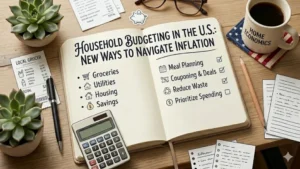

Inflation impacts the buying power of the citizens in the United States of America. So, what does it imply for your day to day life? In essence, inflation diminishes the purchasing power of your money with time hence getting less in value for a certain amount of money.
Knowing how this works will assist you in making right decisions that will enable you to shield your income from rising cost of living. Now, let’s have a closer look at the effects of inflation on your purchasing power to understand this key financial term from the changes in daily expenses to the adjustments of investment plans.
Understanding how inflation decreases your money’s value

Inflation is defined as the speed at which the overall price level of the goods and services in an economy is rising, thus diminishing the value of your money. This can be seen when you find that a gallon of milk today is relatively expensive than what it was a few years ago. With inflation, one dollar can only buy less as the prices of the goods and services to buy rise.
Inflation can be caused by many conditions such as supply and demand difference, rise in production costs, and monetary policies. Inflation reduces purchasing power and hence when inflation is high people have to spend more to acquire the same goods and services. This is why one has to look at the effects it has and make sure to work towards the achievement of financial stability in the future.
The impact of inflation on everyday expenses
Inflation may be felt in the simplest way possible and that is through your spending every day. From food items to power, the overall inflation implies that you have to spend more of your income on necessities. For example, housing costs can rise with the inflation rate and this affects both the renters and the homeowners.
Besides shelter, other necessities like fuel, medical services, and learning are also subjected to increase during inflation. These spending categories affect your monthly budget in a huge way, making you either cut down on your expenses or find a way to make more money to cater for the expenses.
Long-term effects on savings and investments
Inflation does not only affect how much you spend in the present but also on the future of your money through your savings and investments. Money in a normal saving account is worth less as the years go by especially when the interest being earned is less than the inflation rate.
Investing is another sector that is bound to be influenced by inflation. For instance, bonds provide a fixed rate of return and this may not be enough to beat inflation hence a real value loss. However, there are exemptions such as stocks, real estates and commodities as most of them are likely to appreciate with the general inflation rates.
Strategies to mitigate the impact of inflation
Alas, people cannot avoid the consequences of inflation completely, but there are some ways to protect one’s assets. An important aspect is tracking the expenses and knowing how and where the money is being spent to be able to make changes if necessary. Reducing your spending on the things you do not really need is a good way to make your money last longer.
Also, it is advisable to review and make changes to the investment portfolio from time to time. Thus, incorporating the assets that are known to give good returns when there is inflation such as real estate, stock and commodities can act as a shield against rising prices.
Leveraging technology for budgeting and investment
The following are some of the modern tools and applications that can assist you in dealing with inflation’s effects on the purchasing power: It is possible to monitor the spending habits and get recommendations on how one could save more money through the use of budgeting apps.
Investment apps and platforms help in the diversification of the portfolio. Some of the features that you can find include real time tracking and robo advisors and this is a feature that can help manage your investments based on the current market conditions. This way you can be informed and act when need be to safeguard your financial position thus being on the right track.
Regularly reviewing financial goals
The increase in prices of goods and services requires the reassessment of your financial objectives on a regular basis. Whether it is a down payment for a house, funding for a child’s college education, or preparing for retirement, reviewing these goals helps to make them practical due to the changing economic environment.
For instance, it is advisable to contribute more to the retirement accounts whenever there is inflation to ensure you can buy similar goods in the future. Also, it is recommended that you automate your savings and investments to increase them periodically as inflation rates rise.